
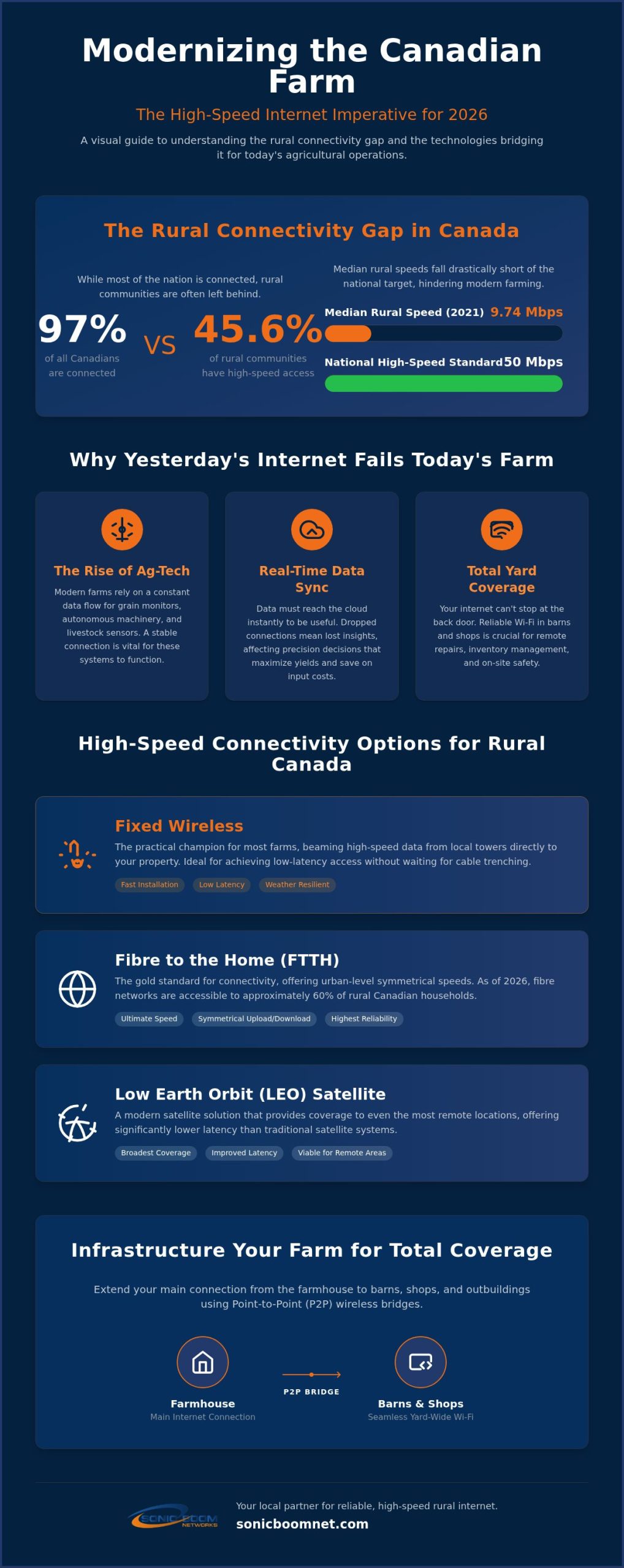
Did you know that while 97% of Canadians are connected, only 45.6% of our rural communities have access to unlimited high-speed internet? It’s a gap that feels even wider when you’re trying to find reliable high speed internet for farms to run a modern operation. You shouldn’t have to worry about your connection dropping during a critical harvest or seeding period. High latency makes remote monitoring impossible; data caps only serve to limit your business growth. We agree that for a Canadian farm in 2026, a reliable connection isn’t a luxury. It’s a tool as vital as your tractor.
This guide shows you exactly how to modernize your connectivity and keep your operation competitive. You’ll learn how new technologies are transforming rural landscapes and which connectivity options deliver the best performance for your specific yard. We’ll preview the latest in 5G fixed wireless, satellite advancements, and local fibre expansions. You deserve a neighbourly service provider that understands rural challenges and provides the low-latency access you need for real-time data. Modernize your farm with seamless, unlimited connectivity starting now.
Key Takeaways
- Understand the national 50/10 Mbps standard and why older DSL connections are no longer enough for modern agricultural operations.
- Compare Fixed Wireless, Fibre, and LEO satellite options to find the best high speed internet for farms based on your specific location and needs.
- Identify why low latency is the critical metric for successful remote monitoring and seamless video communication on the yard.
- Learn how to use Point-to-Point wireless bridges to extend your connectivity from the farmhouse to barns and outbuildings.
- Discover the benefits of choosing a local, no-contract provider that prioritizes reliability and community-centric support over rigid corporate agreements.
Why Traditional Rural Internet No Longer Cuts It for Modern Canadian Farms
The Canadian government defines high-speed internet as a connection with at least 50 Mbps download and 10 Mbps upload speeds. For many operations, this 50/10 standard is still a distant dream. Traditional Rural Internet technologies, like basic DSL, simply can’t keep up with the demands of a 2026 farm. While DSL was fine for checking emails a decade ago, it fails when you need to upload massive data sets or stream high-definition video. This “Connectivity Gap” isn’t just a technical glitch; it’s a barrier to your productivity. In 2021, the median rural download speed was just 9.74 Mbps. When you compare that to the modern standard, it’s clear why older systems are failing your business.
We know the stress of the evening slowdown. It’s that moment when the kids sit down for homework, someone tries to join a video call, and you’re trying to sync field data. The connection chokes. It’s frustrating, and frankly, it’s unprofessional. You shouldn’t have to choose between your child’s education and your farm’s management. You need high speed internet for farms that treats your operation like the high-tech business it is. Relying on a single, weak connection for the whole family and the business is a recipe for burnout.
The Rise of Ag-Tech and the Need for Bandwidth
Modern farming has moved beyond simple web browsing. You’re now managing grain monitoring systems, autonomous machinery, and livestock sensors that require a constant, stable data flow. This is the “Real-Time Farm” where data must hit the cloud instantly to be useful. If the connection drops while your equipment is trying to sync, you lose valuable insights. High-speed data acts as a digital fertilizer for farm yields. It allows you to make precision decisions that save money on inputs and maximize your output every season.
Beyond the Farmhouse: Why Your Whole Yard Needs Coverage
If your internet only works in the kitchen, your business is handicapped. Your shop and barn are no longer just storage spaces; they’re critical offices where you troubleshoot equipment and manage inventory. Reliable high speed internet for farms ensures that a technician can walk you through a complex repair via video call while you’re standing right next to the machine. It also provides a vital safety net. Having a solid connection in a remote outbuilding can be a lifesaver during an emergency. Your connectivity should follow you across the entire yard, not stop at the back door.
The Technologies Delivering High-Speed Connectivity to Rural Areas in 2026
Choosing the right technology is about matching your land’s layout with the right signal. In 2026, we’ve moved past the days of “take what you can get.” Three main contenders now dominate the landscape: Fixed Wireless, Fibre, and Low Earth Orbit (LEO) Satellite. Each offers distinct advantages depending on your distance from the nearest town and your specific operational needs. If you’re still researching your options, our detailed breakdown of how to get internet in rural areas covers every available technology for Canadian properties in 2026. You deserve a solution that fits your farm, not a one-size-fits-all corporate package.
Fixed Wireless: The Practical Champion for Most Farms
Fixed Wireless is a top choice for many Canadian operations. It uses local towers to beam high-speed data directly to an antenna on your roof. You don’t have to wait for months of trenching or expensive cable runs across your fields. This technology is particularly robust for emerging agricultural technology because it provides a stable connection without the signal delay common in older satellite systems. Modern towers have significantly increased their range. This makes it easier to achieve high speed internet for farms even in rolling terrain. It’s often more reliable during heavy Canadian snowfalls than traditional satellite dishes. Installation is typically fast and straightforward. If you need a reliable connection without the wait, exploring our residential and commercial plans is a great first step.
The Fibre Revolution: Urban Speeds in the Field
Fibre-to-the-Home (FTTH) is the ultimate goal for rural modernization. As of April 2026, roughly 60% of rural Canadian households have access to fibre networks. It is the gold standard for a reason. Fibre offers symmetrical speeds; this means your upload is just as fast as your download. This is essential for backing up massive field maps or livestock data to the cloud. Beyond daily performance, fibre-optic infrastructure significantly boosts your property’s resale value. It shows future buyers that the farm is ready for the next generation of digital growth. While it takes longer to build out, a neighbourly provider will prioritize these rural pockets to ensure no one is left behind.
LEO Satellite: Connecting the Furthest Corners
Low Earth Orbit (LEO) satellite services serve as a vital link for the most remote properties. These satellites sit much closer to Earth than older models. This proximity reduces the lag you might remember from the past. It’s a solid “last resort” if you are miles beyond the reach of terrestrial towers or fibre lines. While it’s a great tool for extreme locations, most farms find that fixed wireless or fibre offers a more consistent, local support experience for their primary high speed internet for farms. You want a provider that knows your area, not just a dot on a global map.
Evaluating Your Options: Speed, Latency, and the End of Data Caps
Evaluating the right service requires looking past the flashy “up to” numbers. For a working operation, three metrics dictate your daily experience: download speed, upload speed, and latency. Many national carriers still hide behind punitive data caps, but modern high speed internet for farms has evolved. You shouldn’t have to worry about being throttled because you watched a tutorial in 4K or downloaded a large machinery software update. The myth that rural internet must always be capped or restricted is dead. You need a connection that respects your usage patterns without hidden penalties.
Why Upload Speed is Just as Important as Download
Download speed is how fast you receive data. Upload speed is how fast you send it. While the national 50/10 standard is a baseline, many home offices and farm businesses require more than the bare minimum. If you’re syncing security footage or uploading sensor logs to the cloud, a weak upload connection acts as a bottleneck. It can even “choke” your downloads. Think of it like a two-lane road. If the lane going out is blocked by a slow-moving tractor, the lane coming in can’t move at full speed either. High-quality high speed internet for farms balances these two paths to keep your data flowing smoothly in both directions.
The Latency Factor: Why Satellite Often Feels Slow
Latency is the “hidden killer” of your online experience. It’s the round-trip time it takes for a signal to travel from your farm to the server and back. In plain English, it’s the “lag.” Traditional geostationary satellites have high latency because the signal travels thousands of kilometres into space and back. Fixed Wireless and Fibre have much lower latency because the signal stays closer to the ground. Low latency is what makes your connection feel snappy and responsive. It’s essential for Zoom calls, online schooling, and real-time market trading where a three-second delay can cause frustrating overlaps or missed opportunities.
Unlimited data is now a necessity, not a luxury. Between streaming, gaming, and business operations, the average rural household uses more data than ever before. We believe in transparency and fairness. This means offering unlimited rural internet options without the stress of “overage” fees or surprise bills. You deserve a connection that works as hard as you do, all month long, without the fear of hitting an invisible wall. Modernizing your operation starts with a service that understands these practical needs.
Modernizing Your Operation: How to Infrastructure Your Farm for Total Coverage
Modern farming doesn’t stop at the back porch. To make high speed internet for farms truly effective, you must think beyond a single router sitting in your kitchen. A “whole-farm” network ensures that your data follows you from the home office to the grain bins and the machine shop. We often see operations struggle with weak signals because they rely on consumer-grade gear meant for city apartments. Upgrading your internal infrastructure is the only way to realize the full potential of your high-speed connection and keep every part of your business online.
Bridging the Gap: Connecting Your Outbuildings
Point-to-Point (PtP) wireless bridges are the most practical way to connect your outbuildings. These devices act like an invisible cable, “beaming” your internet signal from the house to a shop or barn up to several kilometres away. This method is significantly cheaper and faster than burying fibre-optic cables across a gravel yard or through tough, frozen ground. To get the best performance, mount these units high on silos or roof peaks to ensure a clear line of sight. Using ruggedized, commercial-grade hardware is a must. Standard equipment simply can’t handle the dust of harvest or the extreme cold of a Canadian winter.
Mesh Wi-Fi vs. Access Points: Which is Right for You?
Many homeowners try to fix dead zones with consumer mesh systems found at big-box stores. While these gadgets work for a standard house, they often fail in modern farmhouses with thick walls, stone foundations, or metal siding. Professional Outdoor Access Points (APs) provide a much stronger, more reliable signal for large yards. They are designed to handle more devices and offer better range for your mobile tablets and sensors. A professional installation might take a bit more planning, but it saves you from the headache of constant resets and dropped calls.
Investing in your yard’s infrastructure pays off. A 2024 study found that rural areas with high broadband adoption saw 213% higher business growth compared to those without. Better coverage allows you to adopt the latest precision agriculture tools that are expected to drive massive industry growth through 2033. If you’re ready to build a network that covers every corner of your yard, explore our Commercial Plans for the reliable hardware and local support your operation deserves.
Sonic Boom Networks: Reliable High-Speed Solutions for the Canadian Agricultural Community
National telecommunications giants often treat rural Canada like an afterthought. We take the opposite approach. Sonic Boom Networks was founded in 2020 specifically to solve the connectivity gaps that hold our neighbours back. We understand that high speed internet for farms is about more than just entertainment; it’s about the survival and growth of your family business. By choosing a local provider, you’re getting a partner that values your operation as much as you do. We’re proud to be the local champion for rural connectivity.
Our “No Long-Term Contract” philosophy is a point of pride. It’s a simple sign of confidence. We believe our service quality should keep you as a customer, not a rigid legal document. This flexibility reduces purchase anxiety and puts you in control of your connectivity. If your needs change or your operation scales, we’re here to adjust right along with you. You can also simplify your monthly bill by bundling your internet with our television and phone bundles. One bill, one local point of contact, and zero hassle.
The Benefits of a Community-Centric Provider
We avoid the cold, corporate distance and technical grandstanding found elsewhere. When you call us, you’re talking to someone who understands rural life and the unique challenges of the Canadian landscape. We focus on practical solutions that actually work in your specific area. Whether it’s troubleshooting a connection during a storm or helping you set up a new outbuilding, we treat every farm like a priority. You aren’t just a account number; you’re a neighbour.
Flexible Plans for Residential and Commercial Needs
Every operation is different. Some farms need residential plans for the house, while others require high-bandwidth commercial plans to run precision ag-tech and remote monitoring systems. Our offerings are designed to be scalable. You can start with what you need today and grow as your digital infrastructure expands. We provide unlimited rural internet options to ensure you never face surprise overage charges or throttled speeds during your busiest seasons. Our commercial-grade plans are built for the heavy data demands of modern agriculture.
Modernizing your farm shouldn’t be a struggle. We’ve spent years building a network that brings urban-grade reliability to the field. It’s time to stop settling for “good enough” and start using a connection that actually supports your goals. Check your address and find your perfect rural internet plan today at Sonic Boom Networks. Let’s get your operation connected with the high speed internet for farms you’ve been waiting for.
Secure Your Farm’s Digital Future
Modernizing your connectivity is about more than just faster downloads. It’s about turning your yard into a high-tech hub where data flows seamlessly from the field to the farmhouse. You now understand why the national 50/10 standard is the essential baseline and how proper infrastructure, like wireless bridges, can transform your daily operations. By prioritizing low latency and choosing unlimited options, you ensure your business remains competitive and your family stays connected.
You deserve a partner that understands the realities of Canadian agriculture. Sonic Boom Networks offers high speed internet for farms with the flexibility you need. We provide unlimited data options and require no long-term contracts. Our neighbourly, community-centric support means we’re always here when you need a hand. Stop struggling with unreliable connections and start building a better digital infrastructure for your operation today.
Modernize your farm with high-speed internet from Sonic Boom Networks. We’re ready to help you thrive in 2026 and beyond.
Frequently Asked Questions
What is the best type of internet for a farm in 2026?
Fibre is the gold standard for speed, but Fixed Wireless is the most practical choice for most Canadian farms in 2026. Fixed Wireless delivers urban-grade speeds without the need for expensive trenching across your fields. It provides the stability required for modern business operations and is much easier to install in rural areas than traditional wired connections.
Can I get high-speed internet on my farm without a satellite dish?
You can absolutely get high-speed connections without a satellite dish by using Fixed Wireless or Fibre-to-the-Home. Fixed Wireless uses local towers to beam data directly to a small antenna on your roof. This setup avoids the high latency and signal delays often associated with older satellite technology; it also stays more stable during heavy rain or snow.
How much speed do I actually need for grain monitoring and ag-tech?
Most grain monitoring and ag-tech systems perform best with at least the national 50/10 Mbps standard. However, if you’re running multiple sensors, security cameras, and a home office simultaneously, you should look for plans that offer higher upload speeds. This ensures your high speed internet for farms can sync data to the cloud without “choking” your other online activities.
Does cold Canadian weather affect fixed wireless internet performance?
Fixed Wireless is designed to be highly resistant to cold Canadian winters and heavy snowfall. Unlike satellite dishes that can lose signal when snow accumulates on the face, Fixed Wireless antennas are much smaller and more robust. The local towers are commercial-grade infrastructure built to withstand extreme weather, ensuring your connection stays live when you need it most.
Is it possible to get unlimited data for rural internet plans?
Unlimited data is now widely available through providers like Sonic Boom Networks. We believe high speed internet for farms should never come with punitive data caps or surprise overage fees. You can stream tutorials, work from home, and manage your operation’s data flow without worrying about hitting an invisible wall or paying for extra gigabytes.
How can I extend my Wi-Fi signal from the house to my barn or shop?
The best way to extend your signal is by installing a Point-to-Point (PtP) wireless bridge. This technology “beams” the signal from your house to an antenna on your barn or shop up to several kilometres away. It’s a much simpler and more cost-effective solution than burying cables across your yard or trying to use weak consumer-grade Wi-Fi extenders.
Why should I choose a no-contract internet plan for my farm?
No-contract plans offer you the flexibility to change your service as your farm grows or your needs shift. It’s a sign of confidence from a provider; we believe our service quality should be what keeps you around, not a rigid legal document. You avoid the anxiety of being locked into a long-term agreement that might not fit your operation’s future goals.
What is the difference between residential and commercial rural internet?
Commercial plans typically offer higher upload speeds and prioritized reliability for business-critical tools. While residential plans are great for streaming and basic browsing, commercial-grade internet is built to handle the heavy data flow of modern agricultural sensors. Choosing a commercial plan often provides the extra bandwidth needed to keep your farm’s security and monitoring systems running smoothly 24/7.