
Table of Contents
- Why Rural Internet Access Is Still a Challenge
- Fixed Wireless Internet Providers: How They Work
- Satellite Internet: Performance and Trade-Offs
- Fiber-Optic and DSL Availability in Remote Areas
- How to Choose the Right Internet Provider for Rural Areas
- How to Improve Rural Internet Signal and Reliability
- CRTC Broadband Service Objectives: What They Mean for You
- Cost, Data Caps, and Contract Considerations
- Frequently Asked Questions
Last Updated: September 30, 2026
Why Rural Internet Access Is Still a Challenge
Rural connectivity remains a stubborn problem across much of the country. Distance from urban centers, low population density, and the high cost of running cable to remote properties all make it harder for traditional providers to justify building out infrastructure.
Residents and business owners often express frustration with plans that promise high-speed internet but deliver something closer to dial-up during peak hours.
The gap isn’t just about speed. It’s about reliability, data caps, and contracts that lock you in regardless of whether the service actually works.
Here’s the good news. Options have improved. Fixed-wireless, satellite, and fiber expansions now reach many areas that had nothing a few years ago.
Fixed Wireless Internet Providers: How They Work
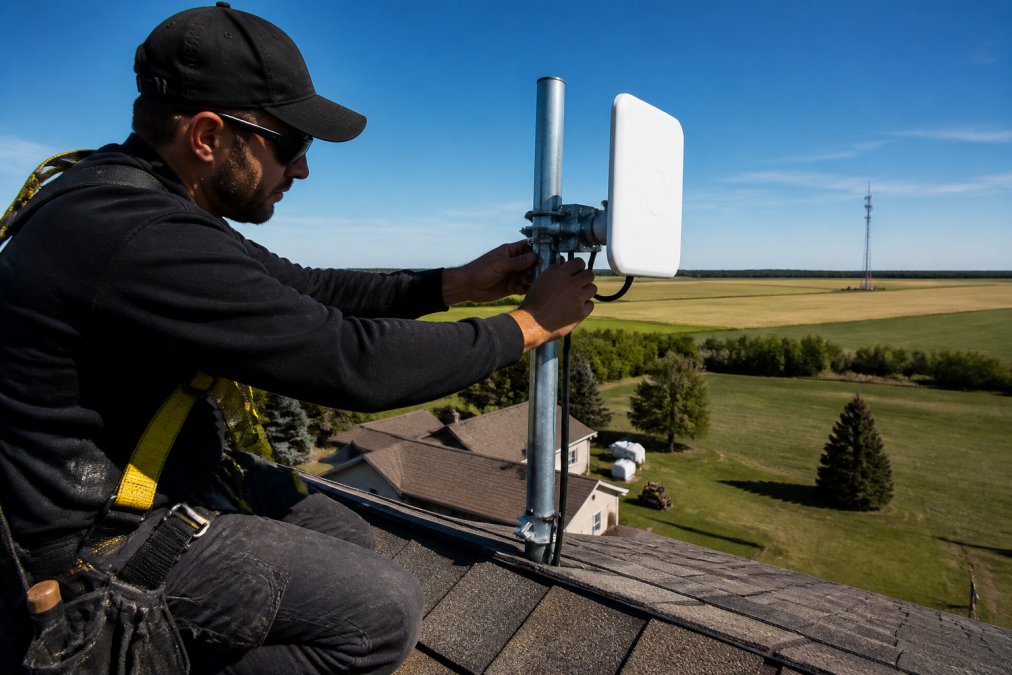
Fixed wireless internet providers deliver a broadband connection by transmitting a signal between a tower and a small antenna mounted on your home or business. No cable trenching required, which is why it reaches places fiber can’t economically go.
Line-of-Sight and Tower Placement
Trees, hills, and even large buildings can block a fixed-wireless signal. Providers usually check this before installation by looking at your property’s position relative to the nearest tower.
Equipment You Need for Fixed Wireless
Most fixed-wireless setups include:
- An outdoor antenna or dish mounted on your roof or a pole
- A cable running to an indoor modem or router
- A power source for the radio equipment
Some providers handle installation; others offer a self-install kit. Professional mounting is usually worth it if your roof is steep or the tower is far away.
Satellite Internet: Performance and Trade-Offs
Satellite internet works almost anywhere because it doesn’t rely on ground infrastructure. That’s its biggest strength and its biggest limitation.
GEO vs. LEO: Why Altitude Is Everything
Traditional satellite service uses geostationary (GEO) satellites parked roughly 35,786 km above the equator. Because they orbit in lockstep with the Earth’s rotation, your dish never has to move. The trade-off is distance: a signal traveling up to a GEO satellite and back covers about 71,000 km round trip, and even at the speed of light that adds roughly 500-600 ms of latency before any network processing.
What Latency Means for Real Rural Use Cases
Most rural internet guides obsess over download speed in Mbps and ignore ping. That is a mistake, because latency, not bandwidth, determines whether a connection feels responsive.
- Video conferencing: A 25 Mbps connection with 600 ms ping will make you talk over everyone on the call. A 25 Mbps connection with 40 ms ping feels natural. Latency, not speed, is the bottleneck.
- Online gaming: Competitive games typically want ping under 60 ms; anything above 100 ms produces visible rubber-banding. LEO satellite can work for casual play; GEO satellite generally cannot.
- VPN and remote desktop: Every keystroke and mouse movement is a round trip. High latency makes remote work feel like typing through molasses.
- VoIP and emergency calls: Voice quality degrades sharply once latency crosses roughly 150 ms.
The Other Trade-Offs
Beyond latency, satellite plans tend to cost more per Mbps than fixed wireless or fiber, and data caps are common, often with reduced speeds once you hit the threshold rather than a hard cutoff. Weather can affect signal strength, particularly heavy rain or wet snow accumulating on the dish. Upload speeds are typically slower than download speeds, which matters for large file transfers, cloud backups, and video calls where you’re the one speaking.
If your only options are satellite, choose LEO over GEO whenever it is available at your address. The monthly price may look similar, but the latency difference changes what the connection can actually do.
Fiber-Optic and DSL Availability in Remote Areas
Fiber-optic internet is the gold standard: fast, symmetric download and upload speeds, low latency, and no signal interference. The problem is reach. Running fiber to a rural property can cost tens of thousands of dollars per kilometer, so providers prioritize denser areas first.
How to Choose the Right Internet Provider for Rural Areas
Choosing an internet provider for rural areas comes down to four questions: What’s available at your address? What speed do you actually need? What does it cost after the promo period? And what happens when something breaks?
| Connection Type | Best For | Typical Limitation |
|---|---|---|
| Fixed wireless | Homes with clear line of sight | Weather and obstruction sensitivity |
| Satellite (LEO) | Truly remote locations | Higher cost, data caps |
| Fiber | Areas with new buildout | Limited availability |
| DSL | Legacy phone-line areas | Speed drops with distance |
Signing a long-term contract before confirming service quality at your exact address is the fastest way to get stuck. Ask about trial periods or month-to-month options before committing.
How to Improve Rural Internet Signal and Reliability
Improving rural internet signal and reliability usually starts with your own setup, not your provider. Small changes to where your router sits and what antenna you use can make a noticeable difference.
Router Placement and Antenna Upgrades
Place your router in a central, elevated spot away from metal objects, thick walls, and appliances like microwaves. Every wall between the router and your device weakens the signal.
Check your ping and download speeds at different times of day. If speeds collapse only in the evening, you’re likely dealing with network congestion on the provider’s side, not a problem with your equipment.
CRTC Broadband Service Objectives: What They Mean for You
The CRTC broadband service objectives set a national target for what counts as acceptable internet service. The goal is universal access to speeds that support modern use: streaming, video calls, and remote work.
Cost, Data Caps, and Contract Considerations
Cost, data caps, and contract terms decide whether a plan is genuinely affordable or just cheap on paper. Monthly subscription prices vary widely by connection type and provider, so it’s worth comparing total cost over a year, not just the first month.
The Hidden Cost of Data Caps
Data caps are the single most misunderstood line item on a rural internet bill, and most guides gloss over them. Here is how they actually work in practice.
- Throttling: Your speed is reduced, often to a fraction of your plan, until the next billing cycle. Streaming may drop to standard definition; video calls may become unusable.
- Overage charges: You are billed per additional gigabyte, sometimes in blocks. A single 4K movie can consume 7-10 GB, so a family that streams nightly can blow through a cap quickly.
- Hard cutoff: Service stops until you purchase a top-up or the cycle resets.
- Video conferencing: roughly 1-2 GB per hour per person
- HD streaming: roughly 3 GB per hour
- 4K streaming: roughly 7 GB per hour
- Online gaming: modest data, but large game downloads can hit 50-100 GB each
- Cloud backups and software updates: highly variable, often tens of GB
Contract Terms to Read Before You Sign
Beyond caps, watch for these:
- Installation fees that aren’t disclosed upfront, especially for fixed wireless where a technician visit and antenna mount may be required
- Equipment rental fees for modems, routers, and satellite dishes, these can add a meaningful amount to the effective monthly cost
- Contract lock-ins that keep you paying even if speeds disappoint, sometimes with early-termination penalties
- Promotional pricing that expires after 6 or 12 months, after which the rate can jump substantially
- Speed guarantees, or the lack of them. Many rural plans advertise “up to” speeds with no commitment to a minimum
A Simple Way to Compare Plans
Add up the following over a 12-month horizon: monthly subscription × 12, plus installation, plus equipment rental × 12, plus any expected overage charges. Then divide by 12 to get a true monthly cost. Compare that number, not the promotional headline, across providers.
Before signing a long-term contract, confirm service quality at your exact address. Ask about trial periods or month-to-month options. A provider’s coverage map is not a guarantee of performance at your property.
Frequently Asked Questions
Who has the best internet service for rural areas?
The best rural internet provider depends on what technology reaches your address. Fixed wireless internet providers often deliver the best balance of speed, latency, and cost for rural homes. Satellite connectivity works where no terrestrial option exists but has higher latency. Fiber-optic is ideal when available, though it rarely reaches remote properties. Check coverage maps for your specific address and compare upload speeds, data caps, and contract terms before deciding.
How can I get better internet in rural areas?
Start by checking whether fixed wireless or fiber-optic service has expanded to your area. If you are stuck with satellite or DSL, improve your setup: move your router to a central, elevated spot, upgrade to a Wi-Fi 6 router, and add a signal booster or external antenna if your provider supports one. Reducing network congestion by scheduling large uploads off-peak also helps. If speeds remain poor, contact your ISP about hardware upgrades or a different plan tier.
What are the differences between satellite and fixed wireless internet?
Satellite internet beams signals to low-earth orbit or geostationary satellites, so it works almost anywhere but typically has higher latency (especially geostationary) and stricter data caps. Fixed wireless uses a terrestrial antenna on your roof to connect to a nearby tower, offering lower latency, higher bandwidth, and often unlimited data, but it requires line-of-sight and a tower within range. Satellite is the fallback; fixed wireless is usually the better daily driver when available.
How do I check internet availability for my specific address?
Enter your full civic address on provider websites to see coverage maps and available plans. For fixed wireless, providers may ask about tree cover and terrain because line-of-sight matters. The CRTC broadband service objectives aim for 50 Mbps download and 10 Mbps upload, so use that as a benchmark when comparing options. If no provider shows coverage, contact local ISPs directly; some serve areas that online maps miss.
Rural internet has improved, but the gap between advertised speeds and real-world performance still catches people off guard. The fix isn’t just finding a provider; it’s finding one that fits your location, usage, and tolerance for risk.
Sonic Boom Networks offers contract-free, unlimited-data service built specifically for rural Manitoba, backed by 24/7 support and plans for both homes and businesses. If you’re tired of caps and lock-ins, see our plans and get connected without the guesswork.