
Last Updated: October 28, 2026
Quick Summary
Fixed wireless providers like Sonic Boom Networks are the best rural internet gaming choice, since terrestrial signals beat satellite on ping and jitter. Look for ping under 50 ms, upload of at least 5 Mbps, and no data caps or contracts.
- Ping under 50 ms is comfortable, 50-100 ms is workable, and above 150 ms feels broken.
- Most games run comfortably on 15-25 Mbps down and 5 Mbps up.
- Sonic Boom Networks offers no contracts, no data limits, and support 24/7, 360 days a year.
- Starlink suits remote properties, but weather fade and handoff drops hurt consistency.
- Wired Ethernet beats Wi-Fi for gaming every time.
Table of Contents
- What Actually Matters for Rural Internet Gaming
- The 5 Best Rural Internet Providers for Gaming at a Glance
- 1. Sonic Boom Networks: Contract-Free Gaming Internet Built for Rural Manitoba
- 2. Starlink: Satellite Internet for Gaming in Canada’s Hardest-to-Reach Areas
- 3. UbiFi: A Rural Option Worth Checking for Low Latency Internet in Rural Manitoba
- 4. Rise Broadband: Fixed Wireless Internet Manitoba Gamers Can Weigh
- 5. HughesNet and Viasat: Where Satellite Still Falls Short for Gaming
- What Internet Speed for Online Gaming Do You Actually Need?
- Frequently Asked Questions
What Actually Matters for Rural Internet Gaming
Rural internet gaming lives or dies on one number: latency. Speed tests sell download rates, but a 100 Mbps connection with 80 ms of ping plays worse than a 25 Mbps line sitting at 25 ms. Ping measures the round trip between your machine and the game server, and it decides whether your shots register.
Three specs separate a usable rural connection from an unplayable one:
- Ping: under 50 ms is comfortable, 50-100 ms is workable, anything above 150 ms feels broken
- Jitter: the swing between your best and worst ping; unstable jitter causes rubber-banding
- Upload speed: at least 5 Mbps, because voice chat and game state both travel upstream
We built Sonic Boom Networks around rural Manitoba. If you want to know whether rural internet can realistically support gaming, see how rural connections handle gaming workloads before you commit. Then measure your own line with a proper latency test so you can judge any provider’s claims against real numbers.
The 5 Best Rural Internet Providers for Gaming at a Glance
| Provider | Type | Contract | Data Cap | Best For |
|---|---|---|---|---|
| Sonic Boom Networks | Fixed wireless | None | None | Rural Manitoba gaming |
| Starlink | Satellite | None | None | Remote properties |
| UbiFi | Fixed wireless | Varies | Varies | Low-latency hopefuls |
| Rise Broadband | Fixed wireless | Varies | Varies | Coverage checks |
| HughesNet / Viasat | Satellite | Term-based | Capped | Last-resort coverage |
1. Sonic Boom Networks: Contract-Free Gaming Internet Built for Rural Manitoba
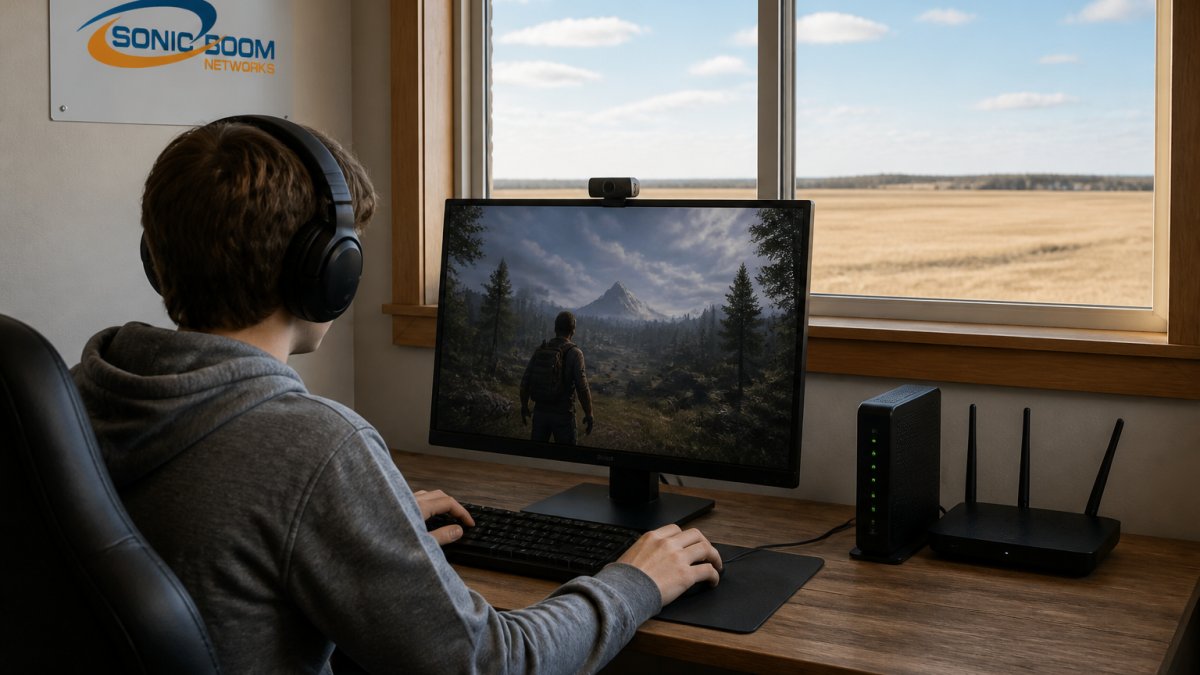
Sonic Boom Networks offers no contracts, no data limits, and support available 24/7, 360 days a year.
Pros:
- No contract requirements, so you can leave if the connection disappoints
- No data limits
- Support available 24/7, 360 days a year
Cons:
- Coverage is focused on rural Manitoba, not the whole country
- Speeds vary by distance and terrain, so we confirm your address first
Best for: families and home workers in rural Manitoba who want internet without a contract.
Skip if: you live outside our service area.
2. Starlink: Satellite Internet for Gaming in Canada’s Hardest-to-Reach Areas
Starlink is the satellite option we would actually consider for gaming, because low-orbit satellites cut the distance the signal travels compared with older geostationary systems. It reaches properties where no wireless tower does, and that alone earns it a place here. The catch is consistency: satellite internet for gaming Canada households use still suffers from weather fade and occasional handoff drops.
Best for: remote properties with no line-of-sight to a tower.
Skip if: a fixed wireless option reaches you, because terrestrial beats satellite on jitter almost every time. If you are weighing the switch, compare Starlink alternatives for rural Manitoba before you buy hardware.
3. UbiFi: A Rural Option Worth Checking for Low Latency Internet in Rural Manitoba
UbiFi markets itself on low latency and stable connections for rural gamers, which is the right pitch. The honest caveat: availability in Manitoba is not confirmed, so treat it as a name to check rather than a recommendation. Ask two questions before anything else: does the signal reach your address, and what ping do existing customers see at peak hours?
Best for: gamers who want to compare fixed wireless quotes.
Skip if: the provider cannot give you a latency figure in writing.
4. Rise Broadband: Fixed Wireless Internet Manitoba Gamers Can Weigh
Rise Broadband shows up on rural provider lists, and fixed wireless internet Manitoba households consider is the right category for gaming. Fixed wireless generally beats satellite on ping because the signal travels to a nearby tower rather than into orbit. Confirm coverage at your address and ask for peak-hour performance, not off-peak marketing numbers.
Best for: rural households comparing fixed wireless options.
Skip if: service does not reach your property.
5. HughesNet and Viasat: Where Satellite Still Falls Short for Gaming
HughesNet and Viasat cover places nothing else does, and that is their whole case. For gaming, older satellite technology carries latency high enough to make fast-paced online play frustrating, and many plans come with data allowances that throttle you after heavy use. If you are stuck on satellite today, the case for switching to fixed wireless explains what changes.
Best for: email and browsing in the most remote locations.
Skip if: gaming is a priority and any terrestrial option exists.
What Internet Speed for Online Gaming Do You Actually Need?
Internet speed for online gaming is modest: most titles run comfortably on 15-25 Mbps down and 5 Mbps up. Latency, not bandwidth, decides the experience.
Here is how we would size a connection for a rural household:
- Single gamer, HD streaming alongside: 25 Mbps down, 5 Mbps up, ping under 60 ms
- Two gamers plus 4K streaming: 50 Mbps down, 10 Mbps up, ping under 50 ms
- Telehealth or work-from-home uploads on top: 50 Mbps down, 20 Mbps up, wired where possible
Wired Ethernet beats Wi-Fi for gaming every time. If you must use Wi-Fi, sit close to the router and avoid the 2.4 GHz band in a crowded house. For a full breakdown of the numbers, read what internet speed gamers actually need.
Frequently Asked Questions
Is satellite internet good enough for online gaming?
It depends on the system. Older satellite services carry latency high enough to make fast-paced multiplayer games frustrating. Newer low-earth-orbit options reduce that delay considerably, but they still cost more than a ground-based connection and can be affected by heavy weather. If fixed wireless or another local option reaches your property, test that first. Satellite internet for gaming in Canada works best as a fallback where nothing else is available.
What internet speed do I need for online gaming?
Speed matters less than most people think. Most multiplayer games need only about 3 to 10 Mbps of download speed per player, and 1 to 2 Mbps upload. The bigger factor is latency, or ping, which should sit under roughly 60 ms for a smooth experience. A 25 Mbps connection with low latency will beat a 100 Mbps connection with high jitter every time. Look at latency first, then speed.
What is latency in online gaming, and why does it matter?
Latency is the round-trip time for data to travel from your device to the game server and back, measured in milliseconds. High latency shows up as lag, rubber-banding, or shots that register late. Ask each provider for typical ping figures and whether their network uses fiber backhaul.
Can I game online with unlimited rural internet?
Yes, and unlimited data removes a real headache. Pair unlimited data with a stable connection and you have the two things rural gaming needs most.
Rural gaming internet comes down to latency you can trust and a provider that answers when something breaks. We built Sonic Boom Networks for exactly that: no contracts, no data limits, and real support 24/7, 360 days a year across rural Manitoba. Check our plans, confirm your address, and get a connection that holds its ping through the whole match. Get started with Sonic Boom Networks and game without watching the clock.
