
Table of Contents
- What Makes a Service Plan Work for Telehealth
- Internet Speed for Telehealth: How Much Bandwidth Do You Need?
- Internet Data Usage for Video Calls: How Much Data Does a Telehealth Appointment Use?
- Internet Plans for Video Calls: What Features Matter Most
- Rural Manitoba High-Speed Internet: What to Look for in a Provider
- Comparing Affordable Service Plans for Telehealth Services
- Setting Up Your Home for Reliable Telehealth Calls
- Frequently Asked Questions
Last Updated: October 7, 2026
What Makes a Service Plan Work for Telehealth
A telehealth-ready internet plan needs three things: enough upload speed for video, no data caps that punish long appointments, and support you can actually reach when something breaks. Most rural Manitoba households juggle video visits, remote work, and streaming on the same connection, so the plan has to hold up under all of it at once.
We hear the same questions from patients across Winnipeg and rural Manitoba about affordable service plans for telehealth services: will it stay stable, and what happens if it doesn’t? Those two concerns decide whether an affordable service plan for telehealth services is genuinely affordable or just cheap on paper.
Bandwidth alone doesn’t tell the whole story. A plan that advertises big download numbers but throttles uploads will still drop your video call.
The plan that works for telehealth is the one with steady upload speed, no usage limits, and real human support. Download speed is the least important of the three.
Internet Speed for Telehealth: How Much Bandwidth Do You Need?
Telehealth video calls generally work well at 10-25 Mbps of upload speed for a single high-definition session. The Canadian Radio-television and Telecommunications Commission broadband guidance treats 50 Mbps download and 10 Mbps upload as the baseline for a household, and that’s a reasonable floor for one telehealth appointment running alongside normal home use.
Here’s the catch most guides skip: upload matters more than download for video visits. Your camera sends your image out, and if upload is capped low, you freeze while the other side looks fine.
If two people in the house are on calls at once, double the upload figure. Add a third streamer or a kid in online class, and you want headroom on top of that.
Internet Data Usage for Video Calls: How Much Data Does a Telehealth Appointment Use?
A typical telehealth video appointment uses roughly 0.5 to 1.5 GB per hour, depending on resolution. That adds up faster than most people expect across a month of regular visits, remote work, and streaming.
Data limits are where “affordable” plans quietly stop being affordable. Once you hit a cap, providers either slow your connection or charge overage fees, and a slowed connection is worse than useless for a medical consultation.
- A 30-minute video visit: about 0.3-0.75 GB
- A one-hour appointment: about 0.5-1.5 GB
- A month of weekly visits plus streaming: easily into the hundreds of GB
An unlimited plan removes the guesswork. You stop watching a meter before every appointment.
Internet Plans for Video Calls: What Features Matter Most
The features that matter for video calls are stable upload speed, no data caps, and support that answers when you call. Everything else is secondary for telehealth use.
Ask any provider one question before you sign: “What is my guaranteed upload speed at peak evening hours?” A plan that only quotes download is hiding the number that decides whether your video call holds up.
Look for these when comparing internet plans for video calls:
- Consistent upload speed rather than a peak figure that only shows up at 3 AM
- No data limits, so a long appointment never triggers a slowdown
- No long-term contract, so you can leave if the service doesn’t deliver
- Support hours that match when you actually need help
For a telehealth patient in Winnipeg booking evening appointments, that last point matters more than the advertised top speed.
Rural Manitoba High-Speed Internet: What to Look for in a Provider
Rural Manitoba high-speed internet lives or dies on two things: whether the provider actually reaches your property, and whether the connection stays up. Distance and terrain affect rural service in ways city customers never think about.
When you’re evaluating a provider near you, ask:
- Does the service reach my specific address, and how is that confirmed?
- What happens if the signal doesn’t work after installation?
- Is there a contract locking me in if it doesn’t perform?
- Can I reach a real person at 2 AM on a Sunday?
That last question isn’t hypothetical. If you run telehealth consultations from home, a connection failure at an odd hour costs you a client. A provider that answers the phone around the clock is worth more than one with a slightly faster advertised speed.
Comparing Affordable Service Plans for Telehealth Services
The right affordable service plan for telehealth services comes down to matching the plan to how you actually use the connection, not chasing the biggest number on the page.
| What to Check | Why It Matters for Telehealth | What to Avoid |
|---|---|---|
| Upload speed | Carries your video and audio out | Plans quoting download only |
| Data limits | Long or frequent visits burn data | Capped plans with overage fees |
| Contract terms | Lets you leave if it underperforms | Multi-year lock-ins |
| Support hours | Failures happen outside business hours | Business-hours-only help |
| Rural coverage | Determines if service reaches you | Vague coverage promises |
Sonic Boom Networks provides no contracts, no data limits, and support available 24/7, 360 days a year. For rural households that need a connection they can count on for medical appointments, that combination removes the three biggest sources of stress.
Pricing varies by plan and location, so check our current plans for what fits your household.
Rural Manitoba households and home-based telehealth practitioners who need steady upload speed and no data caps, and who want to avoid a long-term contract.
Setting Up Your Home for Reliable Telehealth Calls
A good plan still needs a sensible setup. Place your router centrally and off the floor, keep it away from thick walls and metal appliances, and use a wired connection for your main telehealth device if you can.
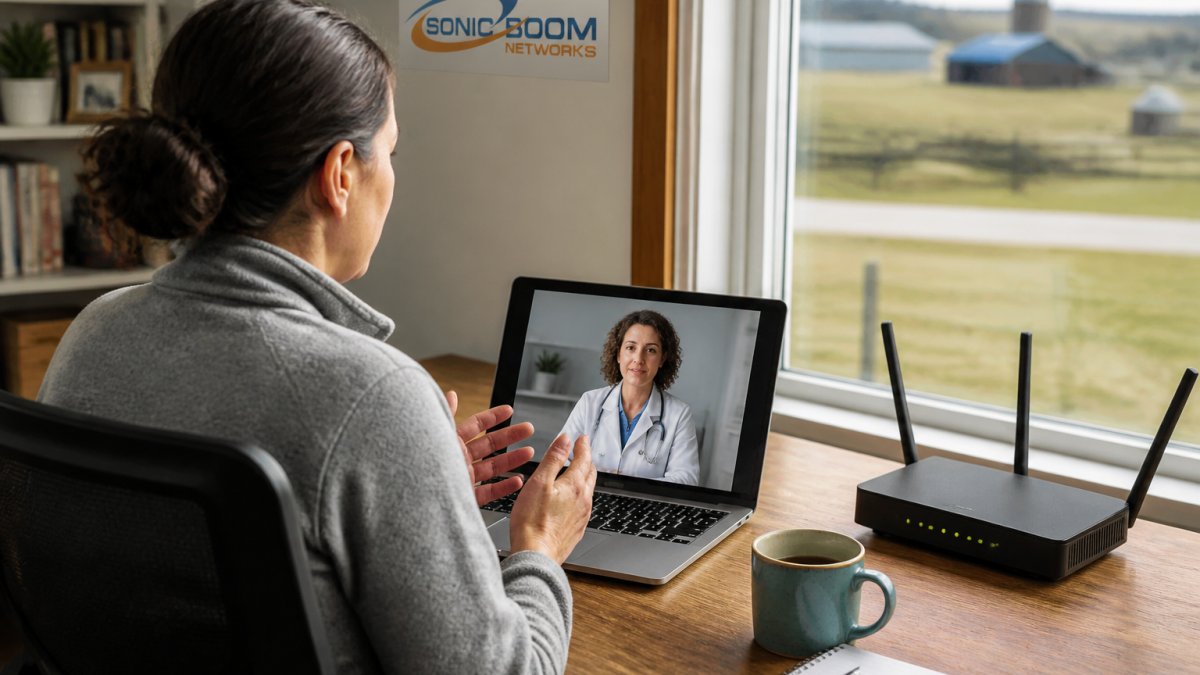
A few practical habits make a real difference:
- Run a speed test before an important appointment, not during it
- Close background apps and pause large downloads during visits
- Keep a phone hotspot as a backup for critical consultations
- Note your provider’s support number somewhere you can find it fast
If you work from home doing telehealth, treat your connection like the business tool it is. Test it, maintain it, and have a fallback ready.
Frequently Asked Questions
What internet speed do I need for telehealth video calls?
For a single telehealth video call, a download speed of at least 10 Mbps and upload speed of 5 Mbps is generally sufficient. If multiple people in your home are streaming, gaming, or on video calls at the same time, aim for 50 Mbps or higher. Upload speed matters just as much as download for telehealth because your camera and microphone send data to your provider. Check your current speed with a free online test before your appointment.
How much internet data does a telehealth appointment use?
A typical 30-minute telehealth video appointment uses roughly 0.5 to 1.5 GB of data, depending on video quality. Higher-resolution video uses more data. If you have multiple appointments per month plus regular streaming and remote work, a plan without data caps prevents overage fees and slowdowns. Unlimited plans are the safest choice for households that rely on video calls for medical care.
Can I use telehealth with a rural Manitoba internet connection?
Yes, provided your connection meets the speed and stability requirements. Rural Manitoba high-speed internet plans that offer at least 25 Mbps download and 5 Mbps upload with no data caps can handle telehealth video calls reliably. Look for a provider with 24/7 support so you can get help if something goes wrong before an appointment. Wired Ethernet connections are more stable than Wi-Fi for medical calls.
Are there affordable service plans for telehealth services without data caps?
Some providers offer unlimited data plans with no contracts, which are ideal for telehealth because you never risk overage charges or throttling during a video call. Pricing depends on your location and the speed tier you choose. Check the provider’s website for current plan options and availability in your area. A plan without data limits ensures your telehealth appointments run smoothly without interruptions.
Rural telehealth only works when the connection underneath it does. If slow speeds, data caps, or unreachable support have cost you appointments, Sonic Boom Networks offers no-contract plans with no data limits and 24/7, 360 days a year support built for rural Manitoba. See our plans and get a connection you can rely on for every consultation.