
Table of Contents
- Manitoba Internet Providers at a Glance: Connection Types and Pricing
- Rural Internet Options in Manitoba: Fiber, Fixed Wireless and Satellite
- No-Contract Internet Providers in Canada: Why Commitment-Free Plans Matter
- Unlimited Data Internet Plans in MB: What Counts as Truly Unlimited
- Latency, Gaming and Hardware: What Rural Connections Get Wrong
- Government Subsidy Programs and Rural Infrastructure Funding
- How to Choose the Right Manitoba Internet Provider
- Conclusion
- Frequently Asked Questions
Last Updated: October 4, 2026
Manitoba Internet Providers at a Glance: Connection Types and Pricing
Manitoba internet providers fall into three main categories: fiber-optic, fixed wireless, and satellite.
Here’s the uncomfortable truth most comparison lists skip: the fastest advertised speed means nothing if the connection drops during your telehealth call or your point-of-sale system stalls mid-transaction.
| Connection Type | Typical Download Speed | Latency | Best For |
|---|---|---|---|
| Fiber-optic | Highest available | Lowest | Dense areas, heavy uploads |
| Fixed wireless | Moderate to high | Low | Rural properties with line of sight |
| Satellite | Moderate | High | Remote locations with no other option |
Below, we’ll show you exactly how to match each connection type to your situation, and what to watch for before you commit.
Rural Internet Options in Manitoba: Fiber, Fixed Wireless and Satellite
Rural internet options Manitoba residents can actually access come down to what infrastructure reaches your property. Fiber is the gold standard where it exists, fixed wireless fills the gaps, and satellite covers the truly remote.
Fiber-Optic
Fiber-optic internet sends data as pulses of light through glass strands, delivering the highest download and upload speeds with the lowest latency. The catch is reach: fiber buildout follows population density, so many rural properties simply aren’t connected yet. Where fiber is available, it’s the clear winner for households running multiple streams and large file uploads at once.
What to check before assuming fiber reaches you:
- Symmetrical speeds: Fiber is typically the only connection type that offers upload speeds matching download speeds, which matters for video calls, cloud backups, and running a home business.
- Buildout timelines: If fiber is “coming soon” to your area, ask for a written date. Municipal and provincial buildout schedules slip, and you don’t want to wait two years on a promise.
- Installation requirements: Fiber needs a physical drop to your home, which can mean trenching, conduit, or an aerial line. On acreages with long driveways, that installation can be the difference between service and no service.
Fixed Wireless
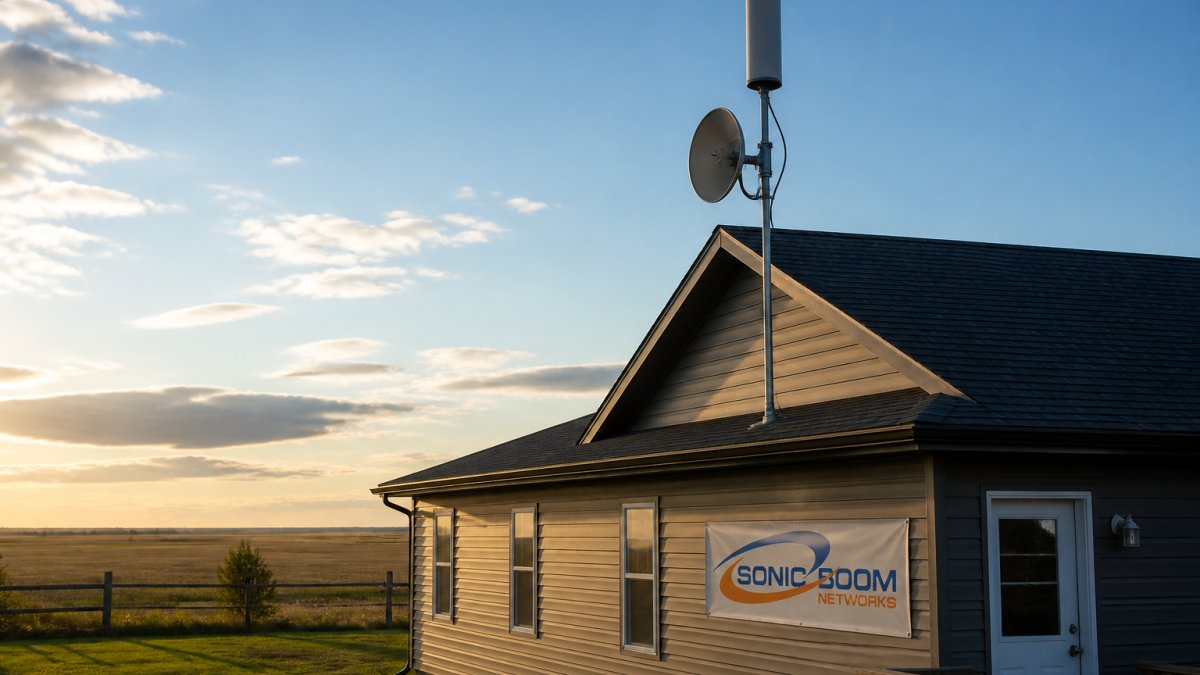
Fixed wireless internet transmits a signal from a tower to a receiver mounted on your property, which makes it the practical choice for rural areas fiber hasn’t reached. It avoids trenching costs and can be installed quickly. Performance depends on line of sight to the tower and distance, so a site check matters before you sign up. For most rural households, this is the sweet spot between speed and availability.
Three variables determine whether fixed wireless will actually work at your address:
- Line of sight: Trees, hills, and even a neighbor’s new shop can block the signal. A site survey is not optional, it’s the single best predictor of whether your connection will hold up.
- Distance to tower: Signal strength falls off with distance. A property 5 km from a tower with clear sightlines often performs better than one 2 km away behind a tree line.
- Tower capacity: A tower serving a few dozen homes performs differently than one serving hundreds. Ask how many subscribers share your tower and whether the provider has capacity headroom.
Satellite Internet
Satellite internet works almost anywhere because the signal travels to an orbiting satellite rather than a ground tower. That reach comes with trade-offs: higher latency, which hurts gaming and real-time video calls, and performance that can suffer in heavy weather.
Low-earth-orbit (LEO) satellite services have improved on traditional geostationary satellite in recent years, cutting latency substantially, but it still trails fiber and fixed wireless for real-time applications.
How to Decide Between the Three
A simple decision order works for most rural properties:
- Is fiber at your address? If yes, take it. Nothing else competes on latency or upload.
- If not, is there clear line of sight to a fixed wireless tower? If yes, this is almost always the next-best choice.
- If neither, satellite is your fallback. Confirm the hardware return policy and test latency before the window closes.
Don’t pick a connection type by advertised download speed alone. For rural properties, line of sight, distance to tower, and upload symmetry often matter more than the headline Mbps number.
No-Contract Internet Providers in Canada: Why Commitment-Free Plans Matter
No-contract internet providers in Canada let you walk away without early termination fees, and that flexibility matters more in rural areas than anywhere else.
A common mistake is signing a long term to shave a few dollars off the monthly rate, then discovering the speeds don’t hold up during peak hours. Without a contract, you can switch the moment a better option reaches your area.
Before committing anywhere, ask what the cancellation terms look like and whether installation fees are refundable if the service underperforms in your first month. Providers confident in their network rarely need to trap you.
Unlimited Data Internet Plans in MB: What Counts as Truly Unlimited
Unlimited data internet plans MB households rely on should mean no monthly cap and no throttling after a threshold. The word “unlimited” gets stretched, though.
Read the fine print for two things: a data cap and a throttling clause. A plan with neither is genuinely unlimited. If a provider reserves the right to reduce speeds after heavy use, that’s a soft cap in disguise.
Latency, Gaming and Hardware: What Rural Connections Get Wrong
Latency is the delay between sending a request and getting a response, measured in milliseconds as ping. Rural connections often get this wrong because distance and signal type add delay that raw download speed can’t hide.
Gaming performance and telehealth both live or die on latency, not bandwidth. A 200 Mbps connection with 80 ms ping feels worse for a real-time call than a 50 Mbps connection with 20 ms ping.
Hardware Requirements
Hardware requirements for a reliable rural setup go beyond the modem your provider supplies. A quality router handles multiple devices without choking, and a mesh network extends coverage across a large property so the signal reaches every room and outbuilding.
- Modem or receiver: Provided or approved by your ISP; mismatched hardware causes dropouts
- Router: Look for one rated for the number of devices you actually run
- Mesh network: Essential for large homes or separate buildings on the same property
Running a dozen smart-home devices, security cameras, and streaming boxes off a single basic router is the most common cause of “my internet is slow” complaints. The connection may be fine; the hardware is the bottleneck.
Government Subsidy Programs and Rural Infrastructure Funding
Government subsidy programs aim to close the rural connectivity gap by funding infrastructure where private buildout doesn’t pencil out. These programs target the digital divide by subsidizing the cost of extending broadband to underserved communities.
Most competitors listing internet providers skip this entirely, which is a mistake, knowing what’s funded and when can change your buying decision. Here’s how the funding landscape actually works.
The Two Layers of Funding
Broadband subsidies in Canada generally flow through two channels:
- Federal programs: The federal government has run successive broadband funding initiatives aimed at connecting underserved households, often administered through an independent agency that sets target speeds and eligibility criteria. These programs typically define a minimum speed threshold that a community must lack to qualify.
- Provincial programs: Provincial governments run their own complementary funding, sometimes cost-matching federal dollars. Because provincial programs vary, the eligibility rules and application windows differ by province.
What This Means for You as a Resident
Subsidies flow to infrastructure builders, not directly to your monthly bill. That distinction matters: you generally won’t get a discount on your plan from a subsidy program. What you get is the possibility that a provider will build to your area sooner than the market alone would justify.
A common pattern is:
- A community or provider applies for funding to extend service to a defined area.
- Funding is approved and construction is scheduled.
- Service becomes available, often months or years after the announcement.
How to Find Out If Your Area Is Funded
- Check the federal broadband funding map. The federal government publishes an interactive map showing funded and planned projects by region. Search your address to see whether a buildout is already in progress.
- Contact your provincial rural development office. Provincial staff can tell you whether your municipality has an active application or approved project.
- Ask providers directly. When you call a provider for a coverage check, ask whether your address is on a funded buildout list. Providers often know before the public map updates.
If your area is on a funded buildout list, ask for the projected completion date in writing before signing a long-term contract with a different provider. A month-to-month plan preserves your ability to switch the moment the new service goes live.
Government of Canada rural broadband funding programs
Why This Matters More Than a Discount
The real value of subsidy programs isn’t a cheaper bill, it’s the difference between having a viable connection and having none. If you’re on satellite today and a funded fiber or fixed wireless buildout is scheduled for your area, that timeline should shape whether you lock into a two-year contract now or stay flexible.
How to Choose the Right Manitoba Internet Provider
Choosing the right provider starts with three questions: what reaches your address, what latency you need, and whether you want a contract. Answer those honestly and the shortlist writes itself.
Run through this checklist before you commit:
- Confirm which connection types actually serve your address with a coverage map
- Test your real needs: how many devices, how many simultaneous streams, any uploads?
- Ask about typical latency, not just peak download speed
At Sonic Boom Networks, we built our service around exactly these pain points: no contracts, no data limits, and 24/7 support 360 days a year for rural properties. We recommend starting with a coverage check, then matching the plan to your household or business needs.
Troubleshooting Common Connectivity Issues
Troubleshooting common connectivity issues usually starts with isolating the problem. If one device is slow but others are fine, the issue is local; if everything drops at once, it’s the connection or hardware.
- Slow speeds at peak hours: Often network congestion or a soft data cap; check your plan terms
- Frequent dropouts: Usually a hardware or line-of-sight problem; restart the router, then call support
- Weak signal in part of the home: Add a mesh node or reposition the router centrally
Most “internet is down” calls trace back to a router that needs a restart or a device hogging bandwidth. Rule those out before assuming the provider is at fault.
Conclusion
Rural connectivity is genuinely harder to get right than urban service, and the wrong plan will cost you in dropped calls and stalled transactions. Sonic Boom Networks offers no-contract plans, no data limits, and 24/7 support built specifically for rural Manitoba households and businesses. See our plans and find a connection that holds up when it matters most.
Frequently Asked Questions
How do I compare internet plans based on data limits and contract terms?
Start with the data cap: unlimited plans let you stream, game and upload without overage fees, while capped plans charge extra once you pass the limit. Then check the contract term. A no-contract plan lets you leave if speeds or reliability fall short, while a two-year term locks you in. Ask the provider for real-world download and upload speeds in Mbps, not just peak numbers, and confirm whether installation fees apply.
What should I look for when choosing a rural internet provider?
Check four things: coverage at your exact address, upload speed (not just download), latency in milliseconds, and support hours. Rural work, telehealth and point-of-sale systems all depend on stable upload and low ping. Confirm whether the provider offers unlimited data, no contract, and 24/7 support. Ask for a service-area check before you commit, and request a trial period so you can test speeds during peak evening hours.
Are there local internet providers that offer unlimited data?
Yes. Some regional providers in Manitoba build their plans around unlimited data with no throttling, which matters for families streaming, students in online school and businesses running point-of-sale systems. Compare the fine print: some ‘unlimited’ plans still slow your connection after a set threshold. Ask whether the plan throttles, what the typical evening download and upload speeds are in Mbps, and whether there is a contract or installation fee attached.
What government subsidy programs help rural Manitoba residents get connected?
Federal and provincial broadband funding programs, including the Universal Broadband Fund and provincial rural connectivity initiatives, have supported fiber and fixed wireless builds across rural Manitoba. Eligibility and application details change, so check the current program pages before applying. Some programs target households, others target ISPs building infrastructure in underserved areas. If your property sits outside existing coverage, ask your provider whether a subsidy-backed build is planned for your area.