
Last Updated: October 25, 2026
Quick Summary
Real alternatives to satellite internet in Manitoba are fixed wireless, fibre where lines have reached, and cellular-based service. Fixed wireless is the closest direct replacement for most rural properties, avoiding the satellite round trip entirely, while fibre delivers the fastest, most stable connection but only where providers have physically run lines.
- Fixed wireless sends a radio signal a few kilometres to a tower instead of roughly 35,000 kilometres to orbit.
- Fibre offers symmetrical speeds, low latency, and no weather sensitivity, but availability depends on lines reaching your road.
- Judge rural connections on latency, upload speed, peak-hour consistency, and data caps, not download speed alone.
- Run a speed test at 8 p.m., not 8 a.m., when the neighbourhood is streaming.
- Sonic Boom Networks offers no contract requirements, no data limits, and support 24/7, 360 days a year.
Table of Contents
- Why Rural Manitoba Households Are Moving Off Satellite Internet
- Fixed Wireless Internet Manitoba: The Practical Satellite Replacement
- Fibre Internet Manitoba: Where the Lines Actually Reach
- Comparing Rural Internet Providers Manitoba Residents Can Choose
- What High-Speed Rural Internet Manitoba Buyers Should Measure First
- Availability Across Manitoba: Which Option Fits Your Property
- Check Whether Sonic Boom Networks Reaches Your Address
- Frequently Asked Questions
Why Rural Manitoba Households Are Moving Off Satellite Internet
If you live outside a town centre in Manitoba, you already know the satellite routine: a dish on the roof, a hopeful speed test, and a monthly bill that never quite matches the promise. Rural households are moving off satellite because geostationary service carries unavoidable latency, tight data allowances, and weather sensitivity that no plan upgrade can fix. This guide from Sonic Boom Networks covers the real alternatives to satellite internet in Manitoba, what each one actually delivers, and how to judge which fits your property. For a direct side-by-side, see fixed wireless vs satellite internet.
Satellite internet is a connection delivered from a dish to an orbiting satellite and back to a ground station. That round trip is the problem: the signal travels roughly 35,000 kilometres each way, which adds noticeable delay to every click, call, and video frame.
But first, here’s what most guides get wrong. They treat “satellite” as one thing and “everything else” as another. In practice, rural Manitoba has three distinct paths: fixed wireless, fibre where lines have reached, and cellular-based service. Each fails differently.
Canadian Radio-television and Telecommunications Commission broadband data tracks rural coverage gaps, and the pattern is consistent: satellite fills the spaces where wireline and wireless infrastructure haven’t reached.
Below, we’ll show you exactly how each alternative works, what to measure before you commit, and where coverage realistically exists.
Fixed Wireless Internet Manitoba: The Practical Satellite Replacement
Fixed wireless internet in Manitoba is a connection delivered by radio signal from a tower to a receiver mounted on your home or business, avoiding the satellite round trip entirely. For most rural properties, it is the closest thing to a direct satellite replacement: no dish pointed at orbit, no 35,000-kilometre delay, and typically no long contract.
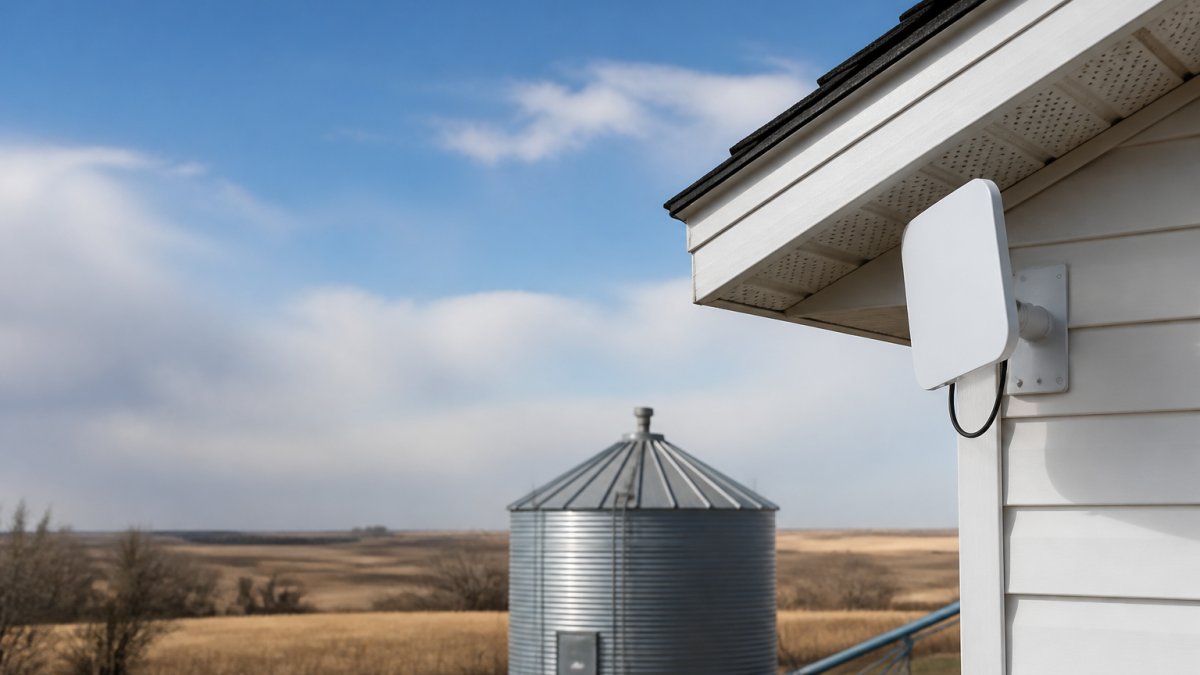
The setup is simple. A small antenna goes on your roof or eave, aimed at a nearby tower. A cable runs inside to a router. That’s it.
How Fixed Wireless Handles Latency, Caps and Weather
Latency is where the difference shows up first. A fixed wireless signal travels a few kilometres to a tower instead of tens of thousands to orbit, so video calls and remote work sessions feel normal rather than delayed. Data caps depend entirely on the provider, which is why “no data limits” is worth asking about directly.
Weather matters less than satellite users expect, but it isn’t irrelevant. Heavy rain, wet snow, and ice buildup can affect signal quality, and extreme cold can stress outdoor equipment. If you want the detail on what rain, snow, wind and cold actually do, read can weather affect wireless internet in Manitoba.
Watch out: a provider that quotes you a speed without a site survey is guessing. Signal strength varies by distance, terrain, and tree cover, so insist on a real assessment of your address before you commit.
Fibre Internet Manitoba: Where the Lines Actually Reach
Fibre internet in Manitoba delivers the fastest, most stable connection available, but only where providers have physically run lines. That’s the catch. Fibre expansion into rural areas is real and ongoing, yet it follows population density and construction economics, which means many properties remain outside the footprint for now.
If fibre has reached your road, take it seriously. Fibre offers symmetrical speeds, low latency, and none of the weather sensitivity of a wireless link.
If it hasn’t reached you, waiting is a strategy with no delivery date. That’s the honest trade-off: fibre is the better technology, and availability, not quality, is what decides the question.
Comparing Rural Internet Providers Manitoba Residents Can Choose
Rural internet providers in Manitoba fall into three categories, and the right choice depends on what’s physically available at your address. Here’s how the options stack up on the factors that actually affect daily use.
| Option | Latency | Data Caps | Contract | Weather Sensitivity | Availability |
|---|---|---|---|---|---|
| Satellite | High | Often capped | Usually 1-2 years | High | Nearly universal |
| Fixed wireless | Low | Varies by provider | Often none | Moderate | Tower-dependent |
| Fibre | Lowest | Rarely capped | Varies | None | Line-dependent |
| Cellular hub | Moderate | Usually capped | Varies | Low | Signal-dependent |
For a broader side-by-side of what’s on offer across the province, see our comparison of Manitoba internet providers: rural options.
Contracts, Data Caps and Support Hours Side by Side
Three details separate a good rural plan from a frustrating one.
- Contract terms. Multi-year commitments make it expensive to leave if speeds disappoint. Month-to-month service keeps the pressure on the provider.
- Data caps. Streaming, online school, and large file uploads burn through allowances quickly. Ask what happens when you hit the cap: throttling, overage fees, or nothing.
- Support hours. Rural outages don’t schedule themselves. A provider reachable only on weekday business hours leaves you waiting through a weekend.
A common mistake is comparing headline speeds only. A slightly slower plan with no cap and real support beats a faster one you can’t use past the midpoint of the month.
What High-Speed Rural Internet Manitoba Buyers Should Measure First
High-speed rural internet in Manitoba should be judged on four measurements, not one: latency, upload speed, consistency during peak hours, and whether the plan carries a data cap. Download speed alone tells you the least about how the connection will feel.
Here’s the checklist we’d use before signing anything:
- Run a speed test at 8 p.m., not 8 a.m., when the neighbourhood is streaming
- Test upload speed separately if you work from home or run a point-of-sale system
- Confirm the latency figure in milliseconds, not just the download number
- Ask in writing whether the plan has a data cap and what happens at the limit
- Confirm contract length and any early termination terms
- Ask what support hours apply and whether you reach a local person
- Request a site survey or coverage check for your exact address
If you’re new to the technology, our practical guide to fixed wireless internet walks through how the signal works and what affects speed at your property.
Availability Across Manitoba: Which Option Fits Your Property
Availability decides this question more than preference does. A property within sight of a fixed wireless tower has a genuine satellite alternative today. A property on a road where fibre has been run has the best option available. A property beyond both is looking at cellular or satellite until infrastructure arrives.
Winnipeg and the surrounding Rural Municipalities sit in a mixed zone: some areas have fibre, others rely on wireless, and a few still depend on satellite. That patchwork is normal for the province.
For properties with outbuildings, home security systems, or a retail shop running a point-of-sale terminal, uptime matters more than peak speed. Ask any provider what their typical outage pattern looks like, not just their advertised uptime.
To match your specific property type to the right option, compare the best internet options for rural properties.
Check Whether Sonic Boom Networks Reaches Your Address
The honest answer to “are there alternatives to satellite internet in Manitoba?” is yes, but only where infrastructure reaches you. Sonic Boom Networks provides high-speed internet for rural Manitoba homes and businesses with no contract requirements and no data limits, backed by support available 24/7, 360 days a year.
We won’t promise coverage we can’t deliver. The first step is a coverage check for your exact address, and if we can’t reach you, we’ll tell you.
Frequently Asked Questions
What are the real alternatives to satellite internet in Manitoba?
Three options cover most rural properties: fixed wireless, fibre where lines have been built, and LTE or mobile hotspot service. Fixed wireless uses a receiver on your roof pointed at a local tower, which keeps latency low enough for video calls and point-of-sale systems. Fibre delivers the fastest speeds but only where providers have run cable. LTE works almost anywhere but usually comes with tighter data allowances. Each one trades coverage against speed and cost differently, so the right pick depends on your address.
Is fixed wireless internet available in rural Manitoba?
Yes, and it is the option most rural households can actually get installed. Fixed wireless depends on line of sight to a tower rather than buried cable, so it reaches acreages, farms and small towns that fibre has not reached. Availability still varies by address: a treed lot or a low-lying property may need a small mast to clear obstructions. Ask any provider to confirm signal at your exact civic address before you commit, and get that confirmation in writing.
Is fixed wireless faster or more reliable than satellite internet?
Fixed wireless usually wins on both counts for everyday use. Because the signal travels to a nearby tower instead of a satellite in orbit, round-trip latency is far lower, which is what makes video calls, remote desktop sessions and card terminals feel normal rather than delayed. Satellite service degrades in heavy rain or snow and often carries stricter data allowances. Fixed wireless is not immune to weather, but tower distance is the bigger factor in whether it performs well at your property.
What should I compare when choosing rural internet in Manitoba?
Compare five things: whether the provider confirms coverage at your address, the upload speed (not just download), whether there is a data cap, contract length, and when support actually answers the phone. Upload matters for telehealth, file transfers and security cameras. A no-contract plan also protects you if service disappoints. Ask for a free trial or a written signal check, and test a video call during peak evening hours before you decide.
Rural internet in Manitoba doesn’t have to mean a dish and a data cap. If you’re tired of latency, limits, and contracts, get started with Sonic Boom Networks and find out whether fixed wireless reaches your property. See our plans and check your address before you commit to another satellite term.
