
Last Updated: November 1, 2026
Quick Summary
The 7 ways to get high speed internet in rural areas are fiber-to-the-home, fixed wireless, low-earth-orbit satellite, geostationary satellite, DSL over phone lines, cellular and 5G home internet, and local wireless ISPs. Confirm which technologies actually reach your exact civic address before signing any contract.
- Fiber-to-the-home delivers the fastest and most stable speeds, but rural density rarely justifies the construction.
- Fixed wireless needs line of sight to a tower, so a site check comes first.
- Geostationary satellite covers nearly every Canadian address but has higher latency and stricter data allowances.
- DSL speed drops sharply with distance, and rural line quality varies enormously.
- Ask providers whether quoted speed is guaranteed or up to, and get answers in writing.
Table of Contents
- Rural Internet Options in Manitoba: The 7 Main Paths
- How to Check Rural Broadband Availability by Address
- How to Improve Rural Internet Speed Without Switching Providers
- Choosing the Right Internet Speed for Rural Homes
- What to Compare Before You Sign Up
- See Which Sonic Boom Networks Plan Fits Your Property
- Frequently Asked Questions
Rural Internet Options in Manitoba: The 7 Main Paths
Finding 7 ways to get high speed internet in rural areas starts with understanding what’s actually available at your property line. At Sonic Boom Networks, we serve rural Manitoba communities, and too many households sign contracts before confirming which technology even reaches their yard. The seven paths below cover every realistic option, from fiber to satellite. Below, we’ll show you exactly what each one delivers, what it costs you in trade-offs, and which questions to ask before signing. For the broader picture on picking a provider, our internet provider for rural areas guide walks through the decision from start to finish.
1. Fiber-to-the-Home
Fiber-to-the-home is a broadband connection that runs a fiber-optic cable directly into your house, delivering the fastest and most stable speeds of any option on this list. When fiber reaches your address, it wins on nearly every measure: upload speed, latency, and reliability during storms. The catch is availability. Fiber builds are expensive, and rural density rarely justifies the construction, so many Manitoba properties simply sit outside the footprint. If fiber is at your door, take it seriously.
2. Fixed Wireless
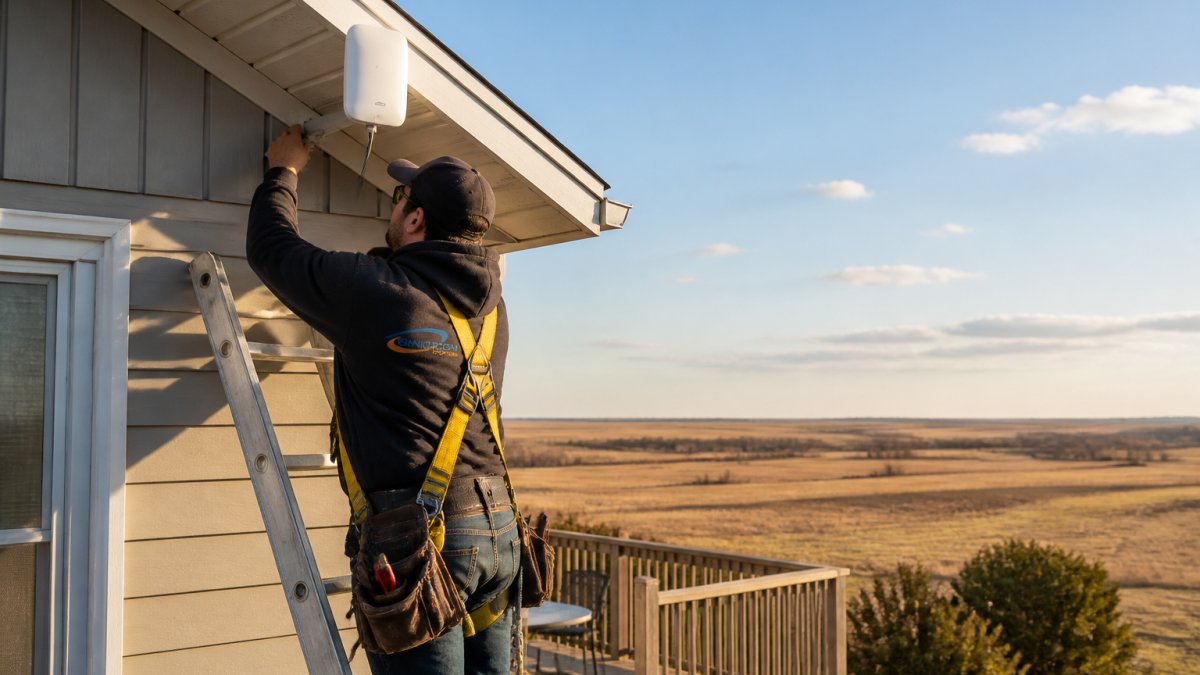
Fixed wireless internet is a broadband service that beams a signal from a local transmission tower to a receiver mounted on your home or business. It’s built for exactly the properties fiber skips. The appeal is straightforward: no buried cable needed, no data caps, and no contract locking you in. Line of sight to a tower matters, so a site check comes first. What fixed wireless internet is and how it works in Manitoba explains the technology before you compare it against the other six paths.
3. Low-Earth-Orbit Satellite
Low-earth-orbit satellite internet uses a constellation of satellites orbiting close to the ground, which keeps latency far lower than older satellite systems. It reaches properties no wire ever will. The trade-offs are real: hardware costs, a monthly bill that runs higher than most terrestrial options, and performance that shifts with weather and network load. For a truly remote cabin or acreage, it’s often the only workable path.
4. Geostationary Satellite
Geostationary satellite internet relies on satellites parked in a fixed position far above the equator. It covers virtually every address in Canada. That coverage comes at a price: higher latency, which makes video calls and online gaming rough, plus stricter data allowances on many plans. It’s the option of last resort rather than a first choice.
5. DSL Over Phone Lines
DSL delivers internet over existing copper phone lines. Where the lines are in good condition and you’re close to the exchange, it’s cheap and simple. Speed drops sharply with distance, though, and rural line quality varies enormously. Many rural Manitoba addresses still have DSL as a fallback, but few would call it high speed by modern standards.
6. Cellular and 5G Home Internet
Cellular home internet uses a mobile network router to deliver broadband over the same towers your phone connects to. Setup is fast and hardware is minimal. The problem is capacity: rural towers carry less bandwidth, and speeds can sag during peak hours. Check coverage at your exact address before committing.
7. Local Wireless ISPs
Local wireless ISPs are regional providers that build their own tower networks to serve rural communities the big carriers overlook. This is where Sonic Boom Networks fits. We focus on rural Manitoba specifically, which means no contracts, no data limits, and 24/7 support, 360 days a year. A regional provider knows the terrain and the gaps.
How to Check Rural Broadband Availability by Address
Rural broadband availability by address is never uniform, so a postal code lookup is a starting point, not an answer. Two properties on the same road can have completely different options depending on line of sight, line condition, and distance from equipment. Here’s how we’d check:
- Look up your address on the CRTC’s broadband coverage map to see which technologies report service at your location
- Call each provider and ask them to confirm service at your civic address, not your town
- Ask what speed is guaranteed versus “up to”
- Confirm whether installation requires a site survey
- Ask about contract terms, data caps, and price changes
- Get the answer in writing before you agree to anything
Watch out: a “service available” flag on a coverage map does not guarantee installation at your specific building. Confirm with a human before you cancel your current provider.
How to Improve Rural Internet Speed Without Switching Providers
Improving rural internet speed often comes down to your own equipment and setup before it comes down to the provider. These fixes cost little and frequently deliver a noticeable gain:
- Move your router off the floor and away from metal, concrete, and appliances
- Switch to the 5 GHz band for devices close to the router
- Add a mesh system or a wireless access point in larger homes
- Update router firmware and replace units older than four or five years
- Run a speed test wired directly to the router to isolate the problem
- Schedule large uploads outside peak evening hours
If speeds stay poor after all that, the issue sits upstream. Our guide on how to improve rural internet signal strength goes deeper into antenna placement and equipment choices.
Choosing the Right Internet Speed for Rural Homes
Picking the right internet speed for rural homes means matching the plan to how many devices run at once, not just to how many people live there. A household with two remote workers, three streaming screens, and a smart thermostat draws far more than a couple who mostly browse.
| Household Profile | Typical Simultaneous Use | What to Prioritize |
|---|---|---|
| Couple, light browsing | 1-2 devices | Basic plan, low latency |
| Family with streaming and school | 4-6 devices | Consistent speed, no caps |
| Remote worker plus family | 6-10 devices | Strong upload, reliability |
| Small business or retail POS | 5+ devices, always on | Uptime, local support |
Our guide to internet plan speeds breaks down how to read a plan’s numbers and match them to streaming, work, and farm use.
What to Compare Before You Sign Up
Comparing rural internet providers comes down to five things: speed, price, data caps, support, and reliability. Most rural buyers focus on the headline speed and ignore the rest, which is exactly how people end up locked into a two-year contract with a cap they didn’t notice.
Ask each provider these questions:
- Is the quoted speed guaranteed or “up to”?
- Are there data caps, and what happens when you hit one?
- Is there a contract, and what’s the penalty for leaving?
- Who answers the phone at 2 AM, and where are they located?
- Can you raise my price mid-term?
You can see how providers stack up on speed, price, caps, and support in our rural Manitoba internet providers comparison. No-contract, no-cap service removes much of the risk from this decision, which is why Sonic Boom Networks offers it.
See Which Sonic Boom Networks Plan Fits Your Property
The hardest part of rural internet isn’t choosing a technology. It’s confirming what actually reaches your address and trusting the provider to deliver it consistently. Sonic Boom Networks serves rural Manitoba with no contracts, no data limits, and 24/7 support, 360 days a year. Confirm service at your exact property with the team before you commit. Get started with Sonic Boom Networks and see which plan fits your property.
Frequently Asked Questions
What are the best options for high-speed internet in rural Manitoba?
The best option depends on what reaches your address. Fiber delivers the fastest and most stable speeds where it has been built out. Fixed wireless and local wireless ISPs serve many rural properties that wired providers skip. Low-Earth-orbit satellite covers almost any location but costs more and has higher latency. DSL works over existing phone lines where the line quality supports it. Check each provider’s availability tool with your exact civic address before deciding.
Is satellite internet a good option for rural areas?
Satellite is often the only option where no wired or fixed wireless service reaches. Low-Earth-orbit satellite offers lower latency than geostationary satellite, which matters for video calls and telehealth. Both types can be affected by heavy rain or snow on the dish. Satellite usually costs more per month than fixed wireless and may carry data priority limits during peak hours. It works best as a fallback when nothing else is available.
Can fixed wireless internet reach homes outside Winnipeg?
Fixed wireless can reach rural homes well beyond city limits, but only where a provider has installed a tower or access point with line of sight to your property. Distance, terrain, and trees all affect the signal. The only reliable way to know is to give a provider your civic address and ask them to run an availability check. Local providers that specialize in rural service are usually the best source for this answer.
How can I improve rural internet speed without changing providers?
Start with your router placement: put it central and high, away from metal appliances and thick walls. Switch to the 5 GHz band for devices close to the router. Run a speed test with a cable directly to the modem to see whether the bottleneck is your Wi-Fi or your connection. If the wired speed matches your plan but Wi-Fi is slow, a mesh system or a Wi-Fi extender can close the gap. If the wired speed is low, the issue is upstream and only the provider can fix it.
What internet speed do I need for streaming and video calls?
For a single HD video call or stream, plan for at least 5 to 10 Mbps download and 3 to 5 Mbps upload. A household with several people streaming, gaming, and on video calls at once should aim higher, often 50 Mbps or more, with upload capacity that matches. Upload speed is the figure rural households most often overlook, and it is the one that decides whether telehealth calls and large file uploads stay smooth.
